

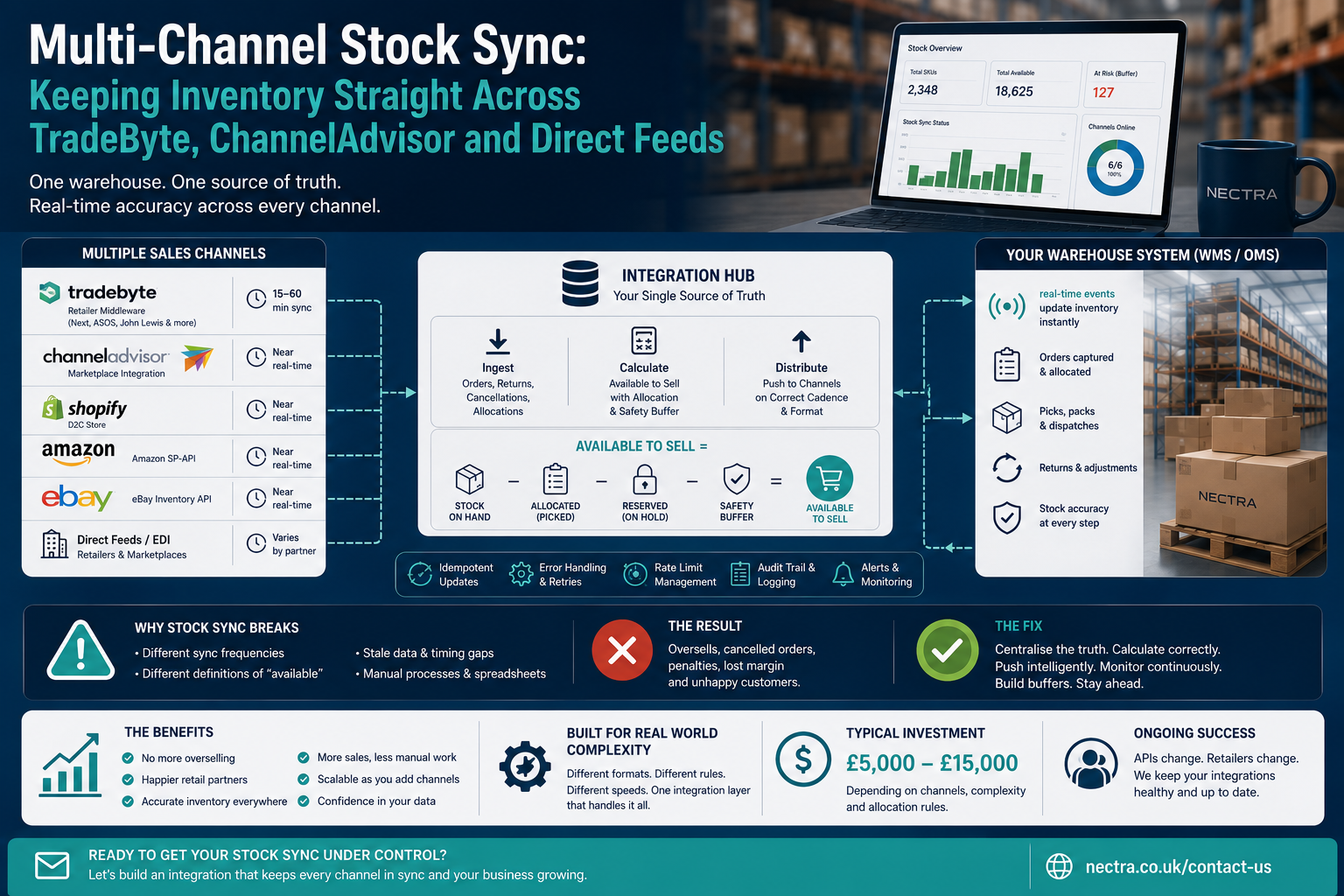
If you sell through more than two or three channels, multi channel stock sync is probably the thing keeping you up at night. Not the sales. The stock. One warehouse, one finite number of units on a shelf, and five or six different platforms all convinced they have the authority to sell the last one. TradeByte, ChannelAdvisor, Shopify, a couple of direct retailer feeds, maybe an EDI connection to a big box retailer. Each one operating on its own schedule, with its own idea of what "available stock" means.
This is where overselling happens. Not because anyone did anything wrong, but because the systems were never actually talking to each other in real time. They were each talking to a copy of the truth, updated on a timer.
Why multi channel stock sync breaks down in practice
Most businesses start with one channel and a simple stock feed. Then a second channel gets added, then a third, and someone builds a spreadsheet or a quick script to keep the numbers roughly aligned. It works, until volume goes up and the gaps between updates start to matter.
The fundamental problem is that these platforms are not built around a single shared inventory ledger. They are built around their own copy of your stock, refreshed on a schedule you don't fully control. TradeByte, for example, is the middleware layer used by a lot of major UK and European retailers (Next, ASOS, John Lewis and others have all used it in various forms). It doesn't pull stock in real time from your system. It pulls on a schedule, often every 15 to 60 minutes depending on how the retailer has configured their side, and it expects a specific XML feed format delivered via SFTP or API. Miss that window, or send a malformed field, and the retailer's site is now selling against stale numbers for the next hour.
ChannelAdvisor works differently again. It's more API-driven and closer to real time, but it has its own rate limits and its own quirks around how bulk inventory updates queue and process. Push updates too aggressively and you can end up with a backlog of pending changes that processes slower than your actual sales velocity, which is its own kind of overselling risk.
Then there are direct feeds: Amazon's SP-API, eBay's inventory API, Shopify's own stock fields. Each has different semantics for what counts as "available", whether reserved or on-hold stock is included, and how quickly a change actually reflects on the storefront.
The overselling trap almost everyone falls into
Here's the gotcha that catches out most businesses building this themselves: available stock is not the same as stock on hand. If your feed logic just reads "units in the warehouse" and pushes that number to every channel, you will oversell, because it doesn't account for units already allocated to orders sitting in the pick queue, units reserved against a not-yet-invoiced order, or units held for a specific retailer under a stock allocation agreement.
The fix isn't complicated in principle: your feed logic needs to calculate available to sell as stock on hand minus allocated minus reserved minus any safety buffer, not just read a raw quantity field. In practice this means your WMS or order management system needs to be the single source of truth, and every channel feed needs to pull from that calculated figure, not from a warehouse count that gets updated on its own separate schedule.
A safety buffer is worth building in deliberately. If TradeByte only refreshes every 30 minutes, and you sell your last unit of a SKU 12 minutes after the last sync, that channel will happily sell it again before it next checks in. Holding back 1 to 3 units as a buffer on fast-moving SKUs, tuned to each channel's actual sync frequency, is a cheap way to avoid the far more expensive job of cancelling orders and apologising to a retailer's supply chain team.
Getting this right: architecture over patchwork
The businesses that get multi channel stock sync under control tend to do one thing consistently: they stop trying to sync channel to channel and instead build a hub. One system holds the real inventory truth, calculates available-to-sell per SKU, and pushes out to every channel through its own connector, respecting that channel's format, rate limits and update frequency. This is exactly the kind of problem API and system integration work is built for: not a single clever script, but a properly designed layer that understands the quirks of each platform and doesn't fall over when one of them changes its API version without much notice (TradeByte and ChannelAdvisor both do this more often than their documentation suggests).
We built this kind of stock hub for Kukoon, who sell across multiple major retailer channels and needed stock and order automation that didn't rely on manual CSV uploads or someone watching a dashboard. The core of it was a central integration layer that calculated real available stock and distributed it out to each retailer feed on the correct cadence, with allocation logic that accounted for orders in flight, not just orders shipped.
A similar principle applied for Silver Mushroom, where stock from more than a dozen suppliers, some sending daily CSV exports, others exposing a near-real-time API, had to be reconciled into a single accurate available-to-sell figure per SKU before it ever reached the Shopify storefront. The alternative was what the business had been doing before: someone manually cross-checking supplier spreadsheets every morning before deciding what could safely go live.
What this costs and what it's worth
For businesses weighing this up: a properly built integration layer connecting three or four channels, with allocation logic and safety buffers, typically sits somewhere in the £5,000 to £15,000 range depending on how many channels and how bespoke the allocation rules need to be. Compare that to the cost of a single significant overselling incident with a major retailer, cancelled orders, damaged account standing, and possibly a chargeback or penalty clause in the trading agreement, and the maths tends to work out quickly.
The other cost worth naming honestly: ongoing maintenance. TradeByte and ChannelAdvisor both change their APIs and feed specs periodically, and retailers using TradeByte as middleware sometimes tweak their own configuration without warning. Budget for a retainer or at least periodic health checks, not a one-off build and forget.
If your stock sync is currently held together by CSV exports, manual uploads, and someone quietly recalculating numbers in a spreadsheet before a big sales event, it's worth talking to us. Get in touch at nectra.co.uk/contact-us and we'll look at what's actually happening under the hood of your current channel setup.