

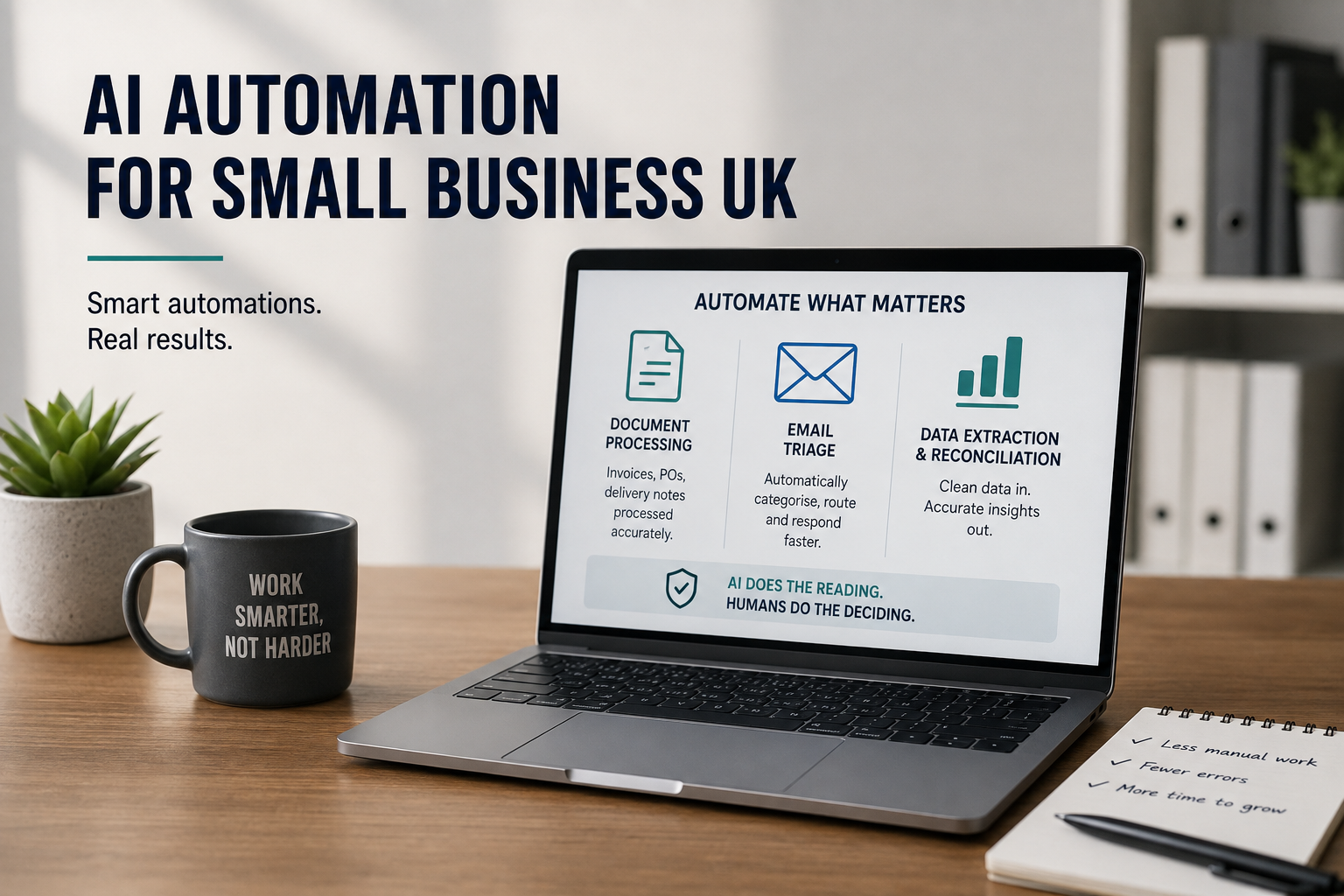
Every SME owner we speak to has had the same pitch by now: some tool promising to run their business while they sleep. The reality of AI automation for small business UK is much narrower than the marketing suggests, and that's not a bad thing. Narrow and reliable beats broad and flaky, especially when the process in question touches customer orders or supplier payments.
We build automations for a living, mostly for fulfilment companies, trade suppliers and multi-channel retailers. So this isn't a theoretical take. It's a list of what we'd actually recommend you spend money on this year, and what we'd tell you to leave alone.
What AI automation for small business UK is genuinely good at today
Three categories of work are mature enough to trust with real business processes: document processing, email triage, and data extraction. All three share a common trait. They take unstructured input and turn it into structured output that a human or another system can act on. That's a much easier problem than making a judgement call, and it's why these use cases work.
Document processing
Invoices, delivery notes, purchase orders, remittance advices. If it lands as a PDF or a scanned image and someone currently retypes it into Sage, Xero or Business Central, that's a strong candidate for automation. Modern document AI models can read a supplier invoice, pull out the line items, VAT, PO reference and total, and post it straight into your accounting system.
Here's the part most vendors won't tell you. Accuracy claims of 95%+ are usually measured on clean, single-format documents. The moment you're dealing with 40 suppliers who each use their own invoice template, some scanned at an angle, some with handwritten annotations, accuracy on a first pass typically drops to somewhere in the 70-85% range. That's still a huge win over manual entry, but you need a review step for the exceptions, not a fully hands-off pipeline. Anyone promising zero-touch invoice processing on day one either hasn't seen your supplier list or isn't being straight with you.
Email triage
Order queries, returns requests, delivery complaints, wholesale enquiries all landing in one inbox, waiting for someone to read, categorise and forward them. AI is genuinely good at reading an email, working out what it's about, and routing it: this one's a return, send to the returns team; this one's a new trade account enquiry, send to sales; this one's a delivery complaint referencing order 48213, pull the order details and attach them automatically.
This is where a lot of the value sits for operationally complex SMEs, because inbox triage is pure overhead. It's also where we'd flag a practical gotcha: if you're automating against a Microsoft 365 mailbox, the Graph API has throttling limits that catch people out once they're processing more than a few thousand emails a day across shared mailboxes. It's manageable, but it needs designing for from the start rather than bolted on when things start failing silently.
Data extraction and reconciliation
Matching a bank statement line to an invoice. Pulling stock levels from five supplier feeds in five different formats and normalising them into one view. Reading a spreadsheet a customer emails you every Monday and getting it into your WMS without someone retyping it. This is exactly the kind of thing we built for Silver Mushroom, where multiple supplier stock feeds needed pulling into one Shopify app automatically, and for Kukoon, where stock and order data had to move cleanly between multiple retailer systems without a human bridging the gap by hand.
None of this is glamorous. It's also exactly where SMEs lose the most hours to copy-paste work that a system should be doing.
What isn't ready: autonomous decisions
Here's where we part ways with a lot of the current hype. Letting an AI system decide things with real consequences, approving a refund over £200, choosing which supplier to reorder from, deciding a customer's credit is good, isn't something we'd recommend building on today. Not because the models can't produce a plausible-sounding answer. Because when they're wrong, they're wrong confidently, and there's often no clean way to catch it before it costs you money or a customer.
The pattern we use instead is AI does the reading and drafting, a human does the deciding. The AI extracts the invoice, flags anything under a certain confidence threshold, and a person approves the batch. The AI drafts a reply to a delivery complaint, and someone hits send. This isn't a compromise position, it's the sensible architecture for the current state of the technology. Full autonomy sounds efficient until the first bad decision costs you more than the automation ever saved.
The rule we work to: automate the reading, keep a human on the deciding, until the cost of a mistake is genuinely trivial.
How to actually start
Don't start with the flashiest use case. Start with the process that's currently eating the most hours for the least judgement required. That's usually invoice entry or inbox triage, not stock forecasting or pricing decisions.
- Pick one process with clear, repeatable inputs (an inbox, a folder of PDFs, a supplier feed).
- Build in a review step for anything below a confidence threshold, rather than aiming for 100% automation on day one.
- Measure it against the actual manual process, in hours and in error rate, not against a vendor's demo.
- Connect it properly to the systems you already run, rather than bolting on another disconnected tool. This is where system integration work matters more than the AI model itself.
If you're weighing up where AI automation for small business UK actually fits your operation, start with whichever bottleneck costs you the most hours: invoice entry, inbox triage, or manual reconciliation between systems. That's a smaller, cheaper problem to solve than most vendors will admit.
If you want an honest assessment of what's worth automating in your business and what isn't, get in touch and we'll tell you straight.